Skip to content
Try it free
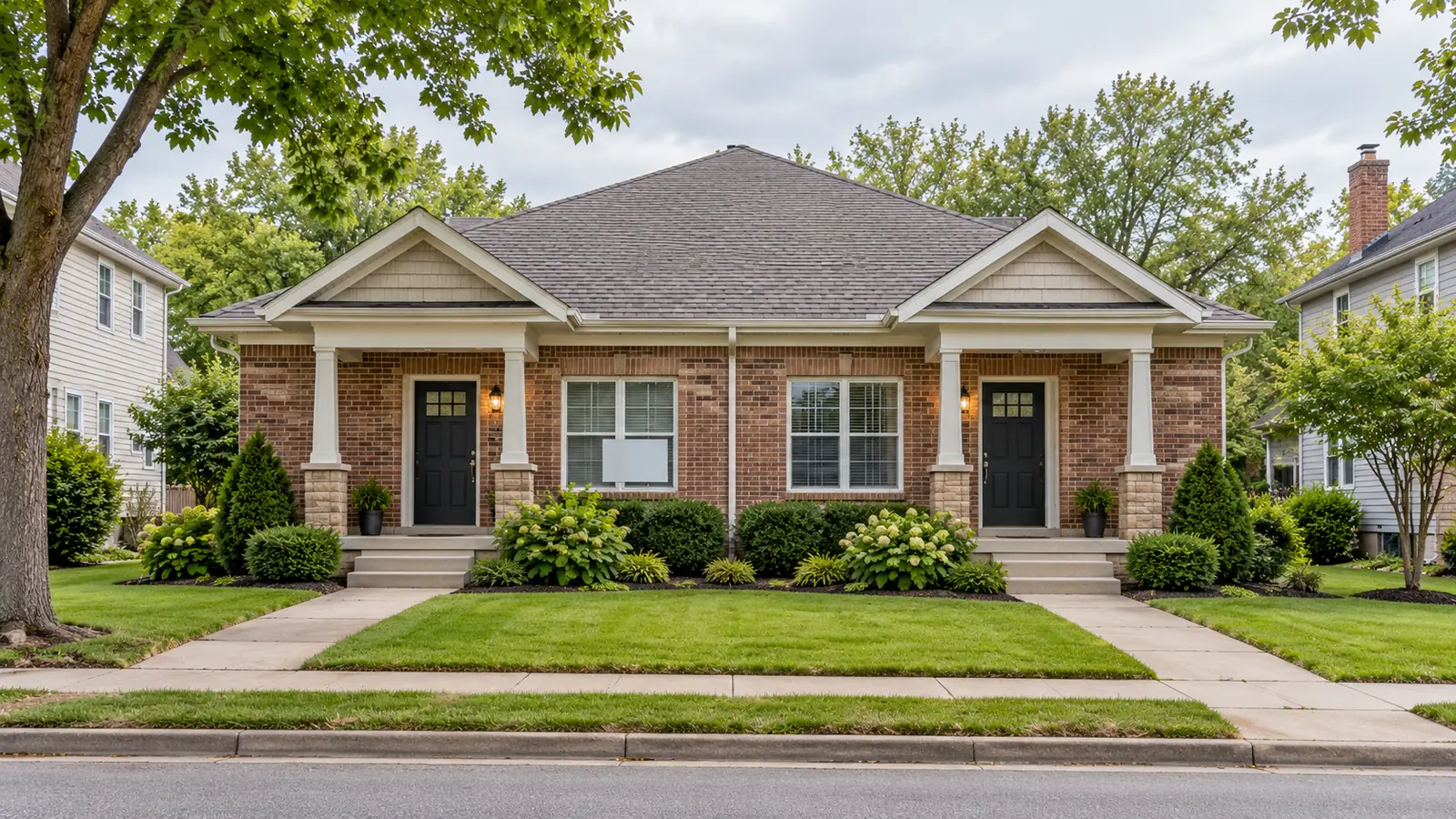
Brick duplex rental property with two front doors and porches
Deal analysis

Rental property cash flow, cap rate and cash-on-cash return: a simple guide

How to calculate rental property cash flow, cap rate and cash-on-cash return, what good numbers look like in 2026, the 1% and 50% rules, and how to find the most you should pay.

LeadCounty editorial and data team2 min read · refreshed weekly

Rental property is the most searched-for real estate calculation, and for good reason: a rental that looks fine on paper can quietly cost you money every month. Three numbers tell you most of what you need: monthly cash flow, cap rate and cash-on-cash return.
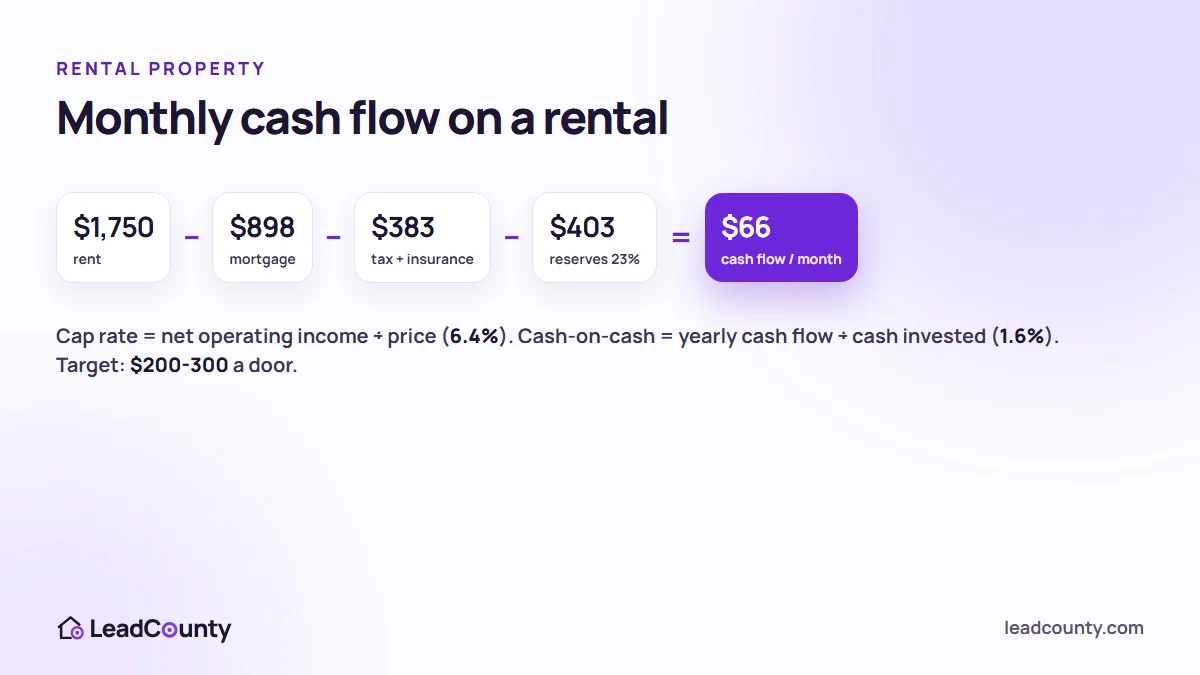
Rental property cash flow formula: rent minus mortgage, taxes and insurance, and reserves, with cap rate and cash-on-cash

01How to calculate rental cash flow

Cash flow = rent − mortgage − property tax − insurance − HOA − reserves. The reserves are the part most beginners skip: vacancy (about 5%), management (8–10%), repairs (about 5%) and capital items like roofs and HVAC (about 5%). That is 20–30% of the rent set aside every month even if nothing breaks.

02A worked example

Price $180,000 with 25% down at 7% for 30 years: the mortgage is about $898 a month. Rent $1,750. Taxes $3,200 and insurance $1,400 a year (about $383 a month). Reserves at 23% of the rent: about $403. Cash flow: $1,750 − $898 − $383 − $403 = about $66 a month. Positive, but thin.

03What is a good cash flow per door?

Many investors want $200–300 a month per single-family house after all reserves. Below that, one repair can wipe out a year of profit.

04Cap rate: comparing properties

Cap rate = net operating income (rent minus operating costs, before the mortgage) ÷ price. In the example the yearly net operating income is about $11,570, so the cap rate is about 6.4%. Cap rate lets you compare properties as if you paid cash. It also prices a deal: value = net operating income ÷ the cap rate you want.

05Cash-on-cash return: your money's return

Cash-on-cash = yearly cash flow ÷ the cash you put in. In the example the investor puts in $45,000 down plus about $5,400 of closing costs. $66 × 12 ÷ $50,400 = 1.6%. That tells you the deal needs a lower price or more rent.

06The highest price for your target

Work backwards: what price gives you $200 a month? The rental cash flow calculator solves it: about $153,000 in this example. That is your offer ceiling.

07The 1% rule and the 50% rule

  • 1% rule: monthly rent should be at least 1% of the price. A ten-second filter; it ignores interest rates.
  • 50% rule: over time, operating costs eat about half the rent. Useful to screen, not to buy.

08Check the lender's view too

Lenders look at DSCR: rent ÷ (mortgage + taxes + insurance + HOA). In the example it is 1.37, which most DSCR lenders accept. The rental calculator shows it next to the cash flow.

09Where good rentals come from

Tired landlords and long-time absentee owners often sell rentals below retail. LeadCounty finds them in county records every week.

Run your rental through the free rental cash flow calculator: cash flow, cap rate, cash-on-cash, DSCR, the 1% rule and your maximum price on one screen.

LeadCounty editorial and data team

We collect official county, court and city records every week and turn them into scored, explained property research for investors and agents. Every guide is based on how these public records actually work.

How we make these guides. We write from official offices and statutes, name the source of each number and fix mistakes when you tell us. See our editorial standards and methodology. What changed: the counts and examples are refreshed weekly.

Free calculators for this guide

Free, no sign-up, every step of the math shown with your numbers.

Questions

How do you calculate cash flow on a rental property?

Monthly rent minus the mortgage, property tax, insurance, HOA and reserves for vacancy, management, repairs and capital items.

What is a good cap rate in 2026?

It depends on the area and risk: often 5–7% in strong neighborhoods and 8–10% or more in riskier areas.

What is a good cash-on-cash return?

Many buy-and-hold investors target 8–12%.

Does the 1% rule still work?

Only as a quick filter. It ignores interest rates, so a property can pass it and still lose money at today's rates.

What is the 50% rule?

A rough rule that operating expenses (not the mortgage) eat about half the rent over time. Use it to screen, then run real numbers.

Sources and further reading

General information, not legal advice. Check the statute and your county office before you act.

Keep reading

All guides →
Real estate investor's desk with a laptop spreadsheet, calculator, floor plan and a model houseDeal analysis

Real estate deal analysis: the 13 numbers that decide a deal (2026)

ARV, repairs, MAO, profit, cash flow, cap rate, DSCR, cash left after a refinance, entry fee and more: what each number means, how to calculate it, and a free calculator for every one.Oct 14, 2026 · 4 min read
Older house under renovation with a dumpster in the driveway and a contractor truckDeal analysis

Does the 70% rule still work in 2026? How pros calculate their offer

The 70% rule is the classic way to find a maximum allowable offer, but many flippers say it no longer fits today's market. Here is what it is, where it breaks, and the strike-price method experienced investors use instead.Oct 13, 2026 · 3 min read
Mortgage papers, house keys, a pen and reading glasses on a kitchen tableDeal analysis

Subject-to real estate deals explained: entry fee, spread and due-on-sale

How a subject-to deal works, how to calculate the entry fee and monthly spread, how it compares with seller financing, and the due-on-sale risk every investor should plan for.Oct 14, 2026 · 3 min read