Call the owners who sell 2.4 times as often.
Behind every score is a model built for one county, trained on years of its own sales. Here is exactly how it works, how we test it and what it cannot do.
The LeadCounty AI score is a 1 to 10 chance-to-sell rating for every property, made by a separate LightGBM model trained on each county's own sales and owner history. In tests on real sales across 77 counties, the top-scored 10% of properties sold a median 2.4 times as often as the county average. Refreshed weekly from official county records.
- A score is a probability. Most 10s do not sell within a year, but they sell several times more often than the rest.
- “Sold” means a deed with a real price in the next 12 months. It does not mean sold to you.
- We publish every county with enough sales for a fair test.
Tested on sales that really happened
Cook County (Chicago), IL
Share of properties that sold within 12 months, from the lowest-scored to the top-scored tenth. The top 10% sold 5.1% of the time against a county average of 1.9%: 2.7× lift.
How the test works
- Turn the clock back. Rebuild the county as it looked a year ago.
- Score every property. The model sees only the older records, never the answer.
- Count real sales. A sale is a deed with a real price in the next 12 months. $0 family transfers do not count.
- Publish it. Every county's result, in full.
Counties by lift
- 2× or better62 of 77
- 3× or better12 of 77
Every tool says AI now. Here is the part they leave out: the test.
The same thing in 30 seconds
A score trained on your county's sales, tested on real ones, with the reasons shown. Every county is different, so we do not use one national guess. For each county we train a model on years of that county's own sales and owner records. Then we test it: we rewind a year, hide the answers, score every home, and see who really sold. In the middle county, the top-scored tenth sold about 2.4 times as often as average. And every score tells you why.
From county records to a score you can explain
- 1County recordsAssessor, treasurer, recorder, courts and city code offices. Public files only.
- 2SignalsDozens of facts per property, each one as it was on a past date. Nothing from the future leaks in.
- 3Model + rulesA LightGBM model for this county learns what came before real sales. Rules keep a 9 or 10 grounded in real events.
- 4Score + reasonsA 1 to 10 score and the three facts that pushed it up, in plain words.
A separate model for every county
A rule that works in Columbus can fail in Dallas. Tax is paid late in different ways, deeds are recorded differently and some counties publish court and code data while others do not. So we do not use one national model. For each county we train a gradient-boosted decision-tree model (LightGBM) on that county's own sales and owner history, and we retrain it at every refresh.
Gradient boosting is a good fit for records like these. It finds combinations, such as a long-held house plus unpaid tax plus an owner who lives out of state, and it copes with gaps, because a county that does not publish a record simply leaves that signal empty.
Rules and model, together
The model ranks. The rules protect you from a lucky guess. A score of 9 or 10 needs a real event on the record: tax past due, a death-related deed or estate owner, a foreclosure, lien or bankruptcy filing, an eviction or a code case. The only other way in is several independent signals backed by a record, such as payment history or a registered rental. Otherwise the score is capped at 8.
If the only signals are that an owner is a company or trust and the house may be empty, the score is capped at 6. If an estate has already sold the house, it drops to 3. Every cap writes its reason in plain words.
The signals it learns from
Every signal comes from an official record. If a county does not publish one, the model works without it and the county page says so.
- Tax owed and years behind
- Late or part payments in the last 6 years
- Unpaid tax carried from earlier years
- Tax owed against the house value
- Is the unpaid tax growing?
- Inheritance and probate deeds
- Estate or heirs on the owner name
- $0 family or trust transfers
- Sheriff and foreclosure deeds
- Absentee and out-of-state owners
- Years owned
- Company, trust or person
- How many properties they hold
- Equity estimate: value against last sale price
- Value change in 1 and 3 years
- Age, size, lot and land use
- Flips and the previous owner's tenure
- How many nearby homes sold in 3 years
- Transfers and sales in 5 and 10 years
- Code cases and vacant-building cases
- Liens, foreclosure and court filings
Seven scores, because investors want different things
The distressed-sale model
A second model asks a different question: will this house sell at a discount or under pressure in the next 12 months? A sale counts when the price is under 70% of the value, or the deed is an estate, sheriff, tax-deed or court deed. It feeds the wholesale and flip scores. In the same backtest, its top-scored 10% had 3.0 times the average rate of distressed sales (median of 69 counties).
Each investor score, tested on its own outcome
A sale is not what every investor is after, so each investor score is checked against the outcome that investor wants. Same held-out year, same rule: the model never saw the answer, and nothing here changes your scores.
When we say 4%, how often is it 4%?
Cook County (Chicago), IL
Properties split into ten equal groups by the model's chance of selling, lowest to highest. Light bars: the average chance the model gave. Dark bars: the share that really sold in the year the model never saw. Where the two bars match, the percentages can be trusted. On average they differ by 0.94% points in Cook County (Chicago), IL. This is the model's own probability before the plain-English rules are applied.
Our own running record
Besides the test above, we freeze today's scores and count later what sold. We are following 482,343 properties scored 9 or 10 in 6 counties. It is too early for a lift: that needs 30 days and a handful of sales in a county.
The score scoreboard →Share a county's result
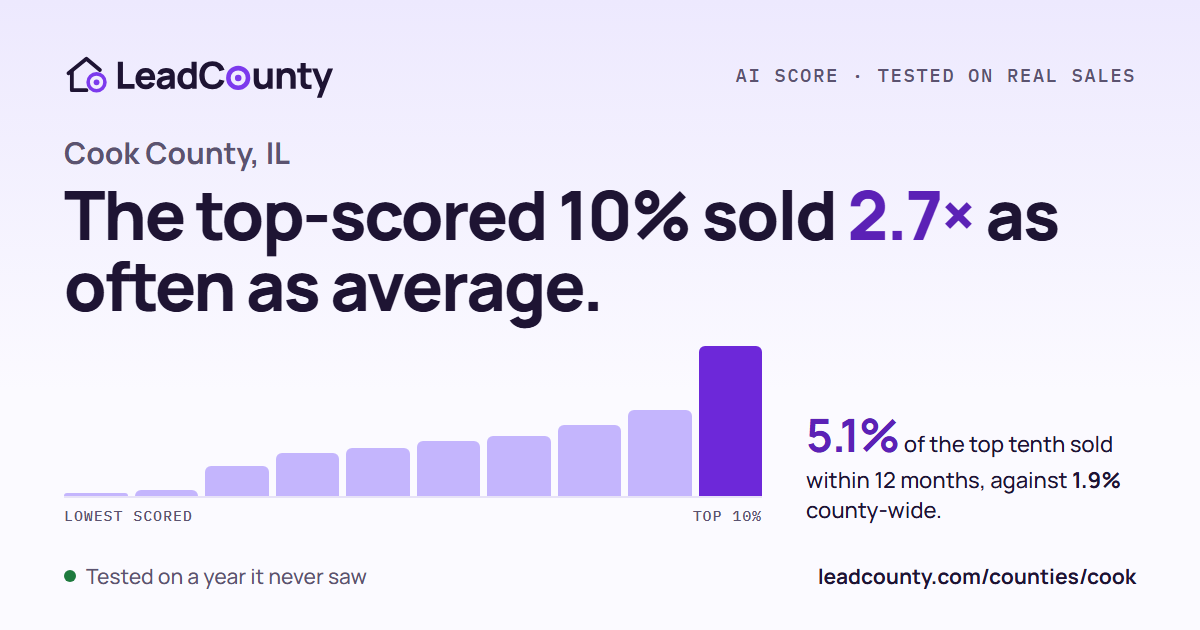

The badge links to the Cook County (Chicago), IL page. It shows the result of the test on real sales.
What a score looks like
- City code case (16 in 2 years)
- Owned 12 years
- Worth 5.4x its last sale price (estimated equity)
Reasons, not a black box
This is an example card in the shape of a Cook County record, with the owner and street hidden. The score is a 10 because the record has an event, not only traits: a city code case, 16 of them in two years, on a house worth 5.4 times its last sale price. Every score in the app shows its top three reasons like these, and the persona scores show their own.
You can also open the methodology for the full list of inputs and limits.
What it does not promise
- A score is a probability. Most 10s do not sell within a year, but they sell several times more often than the rest.
- “Sold” means a deed with a real price in the next 12 months. It does not mean sold to you.
- We publish every county with enough sales for a fair test.
- The model uses only public county records. No phone, credit or broker data.
- Some things cannot be seen in records, such as divorce or job loss.
- Likely-to-sell and distressed-sale are trained models. The wholesale, flip, landlord and tax scores are points added up from facts you can check.
Counties differ: some publish more records than others, so the lift differs, and a county with too few sales for a fair test is not listed. The flip and wholesale scores point to promising houses; they do not know your price or your repair costs. Scores refresh weekly, and a record is never newer than the office that publishes it.
Questions about the AI score
What is the LeadCounty AI score?
A 1 to 10 score for every property that says how likely it is to sell in the next 12 months. A separate gradient-boosted model (LightGBM) is trained for each county on that county's own sales and owner history, then checked by plain rules. Every score comes with its top three reasons in plain English.
Is this real machine learning or just a points system?
Both, and we say which is which. The likely-to-sell score and the distressed-sale score come from trained models. The persona scores for wholesale, flip, landlord, tired landlord, tax lien and tax deed add up points from facts you can check. Rules then keep a 9 or 10 grounded: it needs a real event such as tax past due, a death-related deed or a foreclosure filing, or several independent signals backed by a record.
How is the score tested?
We turn the clock back 12 months, score every property using only the records that existed then, and count who really sold in the following year. The model never sees the answer. We publish the result for every county that has enough sales records for a fair test, in full.
What does 'lift' mean?
Lift compares the top-scored 10% of properties with the county average. If 4% of all properties sold and 12% of the top 10% sold, the lift is 3 times. A random list would show 1 time.
Does a 10 mean the owner will sell?
No. A score is a probability. Most properties scored 10 do not sell within a year. They sell several times more often than average, which is why a list ordered by score finds more deals per call or letter than an unordered list.
Is the AI score just marketing?
Every tool says AI now, which is why we publish the test. We rewind a year, score each property using only the older records and count who really sold, then show the result for every county with enough sales, in full. Check your county on the proof page before you pay.
A lift of 3 times is still a small chance, right?
Right. It means better odds per letter or call, not a sure sale. Most properties scored 10 do not sell within a year; they sell several times more often than the county average, and we say that in plain words everywhere.
Can a model like this overfit?
It can, which is why the test uses a year the model never saw while learning. Rules then keep a 9 or 10 grounded by requiring a real event on record. Some counties score weaker and we show that too. A very high result is checked for leaked answers before we quote it.
How often does the score change?
Scores are rebuilt every week as county records change, and each county's model is retrained at its refresh, so new sales teach it right away.
Does the model use my data or personal information about owners?
No. It uses only public county records: deeds, tax bills, values, owner type, court and code filings. It does not use phone numbers, credit data or anything bought from a data broker.
Put the score to work in your county.
7 days free. Every score, every reason.
- 7 days free
- Explore: no card
- Full access: cancel before day 7, pay nothing
- Max 10 investors per county