Cook County is the largest county in our coverage, with almost 1.9 million parcels across Chicago and the suburbs. Investors search every day for the Cook County tax delinquent list, the tax sale list, the scavenger sale, foreclosure cases and sheriff sales, and probate records. Here is how each one works and how to use them to find owners who may want to sell.
01Is there a Cook County tax delinquent list?
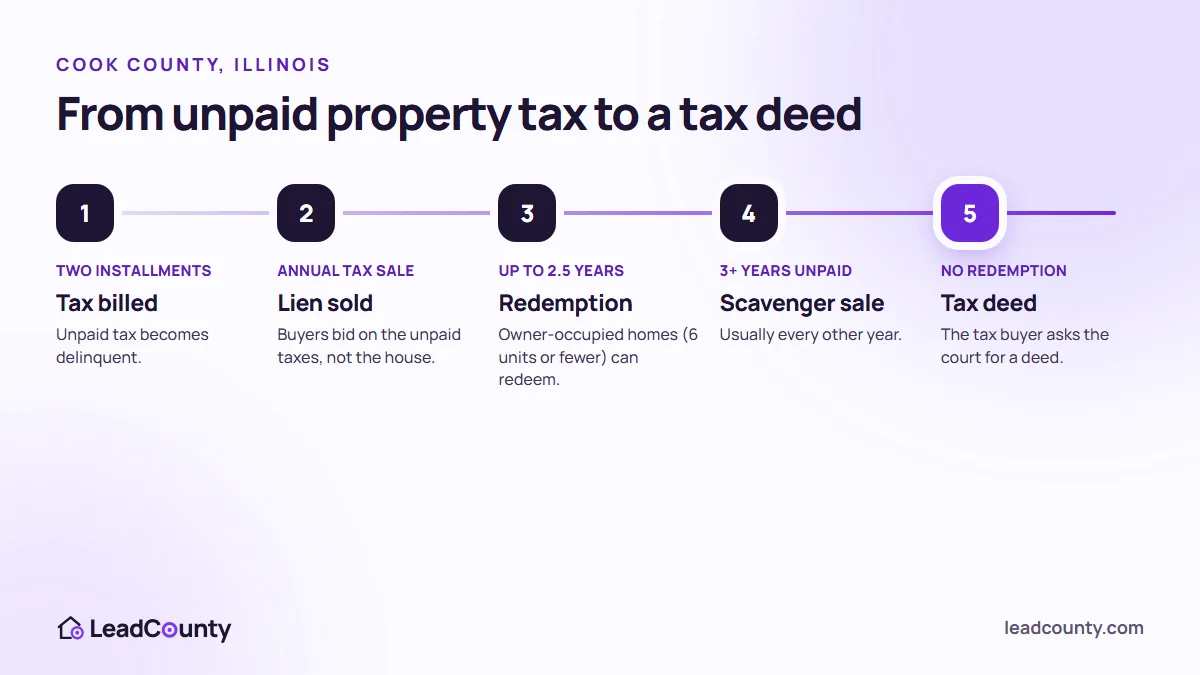
Yes. Cook County property tax is billed in two installments, and any unpaid tax is public record. Delinquent taxes are offered at the annual tax sale, and the list of parcels with unpaid tax is published before the sale. Searching it one PIN at a time is slow; LeadCounty keeps the whole county's delinquent parcels in one list with the owner, mailing address and years unpaid.
02How the Cook County annual tax sale works
At the annual tax sale, buyers bid on the unpaid taxes and receive a lien on the property, not the property itself. The owner can redeem by paying the taxes plus penalties. For owner-occupied homes with six units or fewer the redemption period is usually two and a half years; for vacant land and commercial property it can be as short as six months. If the owner never redeems, the tax buyer can ask the court for a tax deed.
03The Cook County scavenger sale
Parcels with three or more years of unpaid tax that were not bought at an annual sale can be offered at the scavenger sale, which is usually held every other year. Bids can be below the full amount owed. Long-term delinquency like this often means a vacant building, an estate that nobody is handling, or an owner who has given up on the property.
04Cook County foreclosures and judicial sales
Illinois uses judicial foreclosure: the lender files a case in court, the owner is served and can respond, and after a judgment the property is sold at a judicial sale that the court must confirm. Foreclosure cases are public from the day they are filed, which gives an owner months to sell before any sale date. Searching for the "Cook County foreclosure list" or "sheriff sale list" usually means finding these cases early.
05Cook County probate records and inherited homes
Estates are handled by the probate division of the circuit court, and probate cases are public. Inheritance shows up in the property records as an estate, a trust after a death or a transfer to heirs. Heirs often live far away, owe tax on a house they did not choose, and prefer a simple sale.
06Code violations and vacant buildings
Chicago and many suburbs track building code violations and vacant buildings. A vacant building with open violations and unpaid tax is one of the strongest combinations in the county. LeadCounty matches these city cases to the parcel and owner.
07Cook County property records search by owner, address or PIN
Property records in Cook County can be searched by owner name, address or PIN: assessed value, characteristics, sales, tax bills and exemptions. LeadCounty brings the assessment, tax, deed, court and city records together on one page per property, with a likely-to-sell score and the reasons behind it.
08How investors use these lists
- Combine unpaid tax with absentee or out-of-state owners and long ownership.
- Watch new foreclosure filings and new inheritance deeds every week.
- Treat owners with care: many are dealing with debt, a death or a vacant building.
- Run the numbers with the free fix and flip calculator before you make an offer.
All of these Cook County lists are one click in LeadCounty, refreshed weekly. Start a 7-day free trial.