
Skip to content
Try it free
Overstuffed mailbox with identical letters in front of a house
Property data

Why national lead lists go stale, and how fresh county data changes your results

How most lead lists are built, why the same owners get dozens of letters, and what to look for in a data source.

LeadCounty editorial and data team2 min read · refreshed weekly

If you have mailed a "motivated seller" list and heard "you're the 30th investor to write to me this month", you have met the main problem with national lead lists.
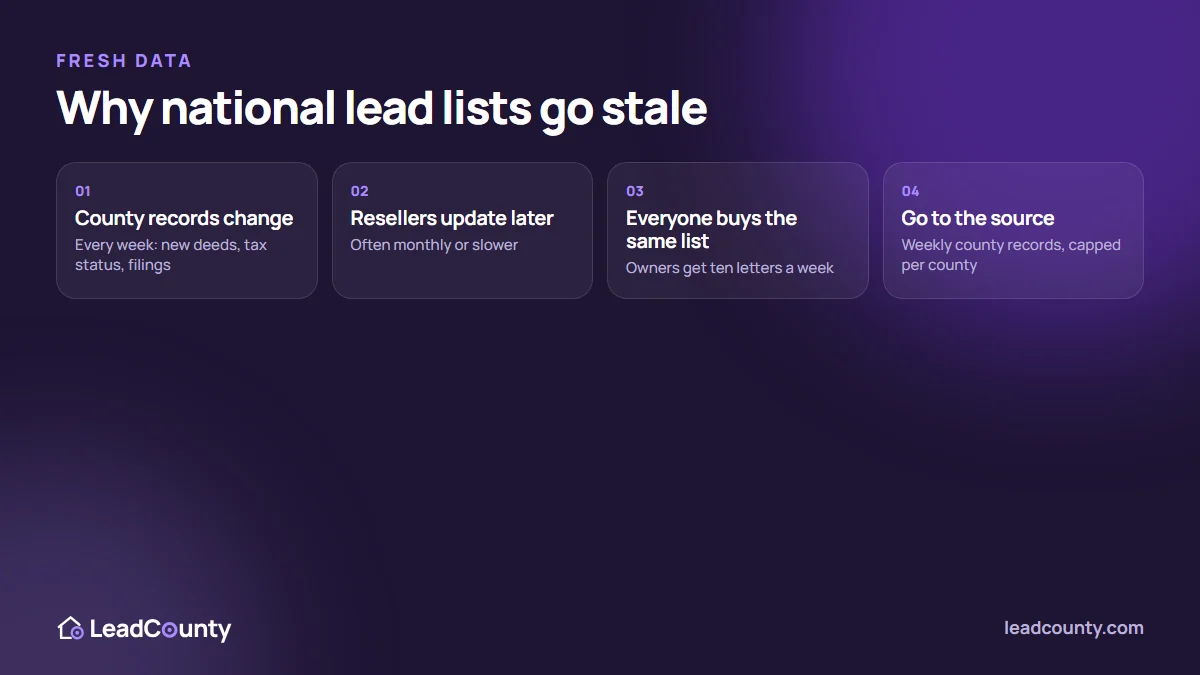
Comparison of national lead lists and weekly county records

01How most lists are built

Large data vendors buy county records in bulk, often on a monthly or quarterly schedule, combine them into one national database and resell it to anyone who pays. Every investor in a market pulls the same filters from the same database at about the same time.

02Three problems

  • Delay: a new inheritance deed or tax delinquency can take weeks or months to reach the vendor. The first investors to act have already called.
  • Crowding: there is no limit on how many people buy the same list, so the best owners get the most mail.
  • Missing signals: court and city records (evictions, code cases, probate) often never make it into national databases because every county and city publishes them differently.

03What fresh data changes

  • You reach owners in the first days after a change, not the first months.
  • You can stack signals that national lists do not have, such as a code violation on an inherited house.
  • With a cap on investors per county, your letter is one of a few, not one of fifty.

04What to ask any data provider

  • Where exactly does the data come from? Ask for the offices by name.
  • How often is each county refreshed?
  • How many other investors in my county get the same list?
  • Can I see why an owner is on my list?

LeadCounty answers all four on every page: the sources are listed per county, every county is refreshed weekly, each county is capped at 10 investors, and every owner shows the reasons behind their score.


LeadCounty editorial and data team

We collect official county, court and city records every week and turn them into scored, explained property research for investors and agents. Every guide is based on how these public records actually work.

How we make these guides. We write from official offices and statutes, name the source of each number and fix mistakes when you tell us. See our editorial standards and methodology. What changed: the counts and examples are refreshed weekly.

Sources and further reading

General information, not legal advice. Check the statute and your county office before you act.

Keep reading

All guides →
Classic American county courthouse with white columns and a clock towerProperty data

Where to find authentic property data (and why the county is the best source)

The official offices that publish property records in the United States, what each one holds, and how to use them without paying for stale lists.Oct 13, 2026 · 2 min read
Real estate investor's desk with a laptop map, a county map and a model houseLead sources

12 signs of a motivated seller you can find in public county records

Tax trouble, inheritance deeds, code violations and more: the public records that point to owners who may want to sell, and how to read them.Oct 13, 2026 · 2 min read
Quiet suburban street with a slightly neglected house and unopened mail on the porchOhio

Tax-delinquent property leads in Ohio: how they work

How Ohio property tax is billed, what 'certified delinquent' means, and how to approach owners who are behind on their taxes.Oct 12, 2026 · 2 min read