
Skip to content
Try it free
Real estate investor's desk with a laptop map, a county map and a model house
How-to

List stacking explained: why owners on three lists beat owners on one

What list stacking is, how the stack score works in LeadCounty, and a few stacks that work well for wholesalers and flippers.

LeadCounty editorial and data team2 min read · refreshed weekly

List stacking means combining several lead lists and focusing on the owners who appear on more than one. It is the simplest way to turn thousands of records into a few hundred owners worth a letter or a call.
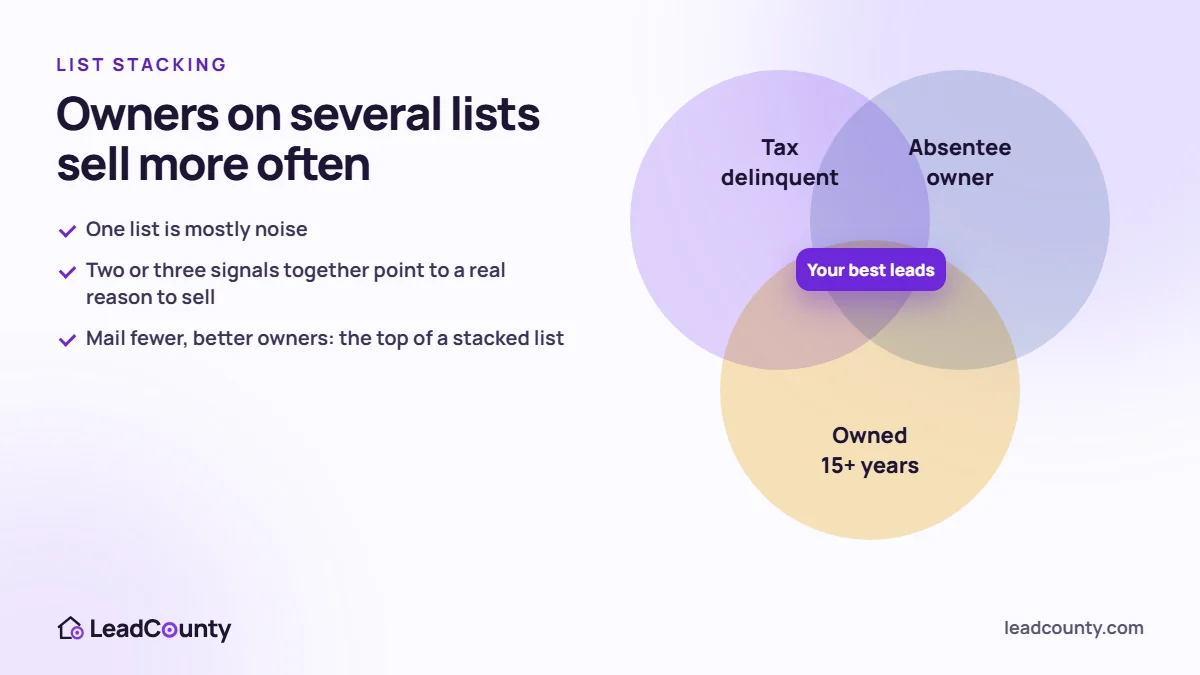
Venn diagram of list stacking: tax delinquent, absentee owner and owned 15+ years overlap

01How it works in LeadCounty

  • Tick the seller lists you care about, for example tax delinquent, absentee owner and owned 15+ years.
  • Give each list a weight: ×1 for a mild signal, ×2 or ×3 for a strong one.
  • Every property gets a stack score: the sum of the weights of the lists it is on.
  • Set a minimum score (for example 3) and sort by score. The reasons are shown next to each property, so you always know why it is on your list.

02Stacks that work well

  • Distressed and absent: tax delinquent + absentee owner + code violation.
  • Inherited and behind: inheritance deed + tax delinquent + out-of-state owner.
  • Tired landlord: portfolio owner + owned 15+ years + eviction filed.
  • Free and clear: owned 15+ years + high equity + absentee owner.

03Keep it fresh

A stack is only as good as its newest record. Save your stack as a search and LeadCounty e-mails you every Monday with the new owners who just reached your minimum score.

04Then add the human check

Open the top results, look at the map and photos, and remove anything that clearly does not fit (a brand-new build, a church, a city lot). A short, clean list beats a long, messy one every time.


LeadCounty editorial and data team

We collect official county, court and city records every week and turn them into scored, explained property research for investors and agents. Every guide is based on how these public records actually work.

How we make these guides. We write from official offices and statutes, name the source of each number and fix mistakes when you tell us. See our editorial standards and methodology. What changed: the counts and examples are refreshed weekly.

Sources and further reading

General information, not legal advice. Check the statute and your county office before you act.

Keep reading

All guides →
Two investors shaking hands over a purchase contract with a house in the backgroundHow-to

Assignment fee vs double close: which wholesaling exit pays more?

How assigning a contract and a double close work, what each costs (transactional funding, title, transfer tax), a worked example and when wholesalers choose each one.Oct 15, 2026 · 2 min read
Real estate investor's desk with a laptop map, a county map and a model houseLead sources

12 signs of a motivated seller you can find in public county records

Tax trouble, inheritance deeds, code violations and more: the public records that point to owners who may want to sell, and how to read them.Oct 13, 2026 · 2 min read
Quiet suburban street with a slightly neglected house and unopened mail on the porchOhio

Tax-delinquent property leads in Ohio: how they work

How Ohio property tax is billed, what 'certified delinquent' means, and how to approach owners who are behind on their taxes.Oct 12, 2026 · 2 min read