
Skip to content
Try it free
Hand holding house keys in front of a modern suburban home
Agents

How real-estate agents find listings before they hit the market

The public-record signals that show a homeowner may list in the next year, and a simple monthly routine for working your farm with them.

LeadCounty editorial and data team2 min read · refreshed weekly

Most listings are won before the homeowner ever talks to an agent. The owner has already started thinking about a move, and the agent who reaches them first, with something useful to say, usually gets the call. Public records show many of those moments early.
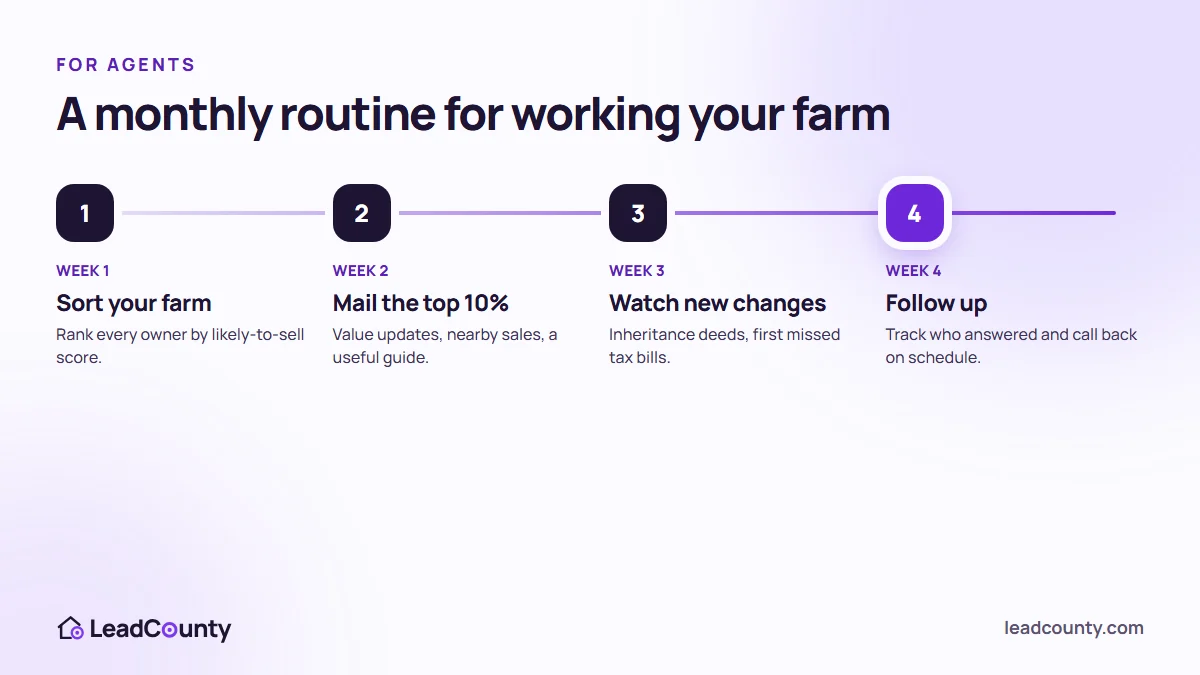
Monthly routine for real estate agents farming an area with likely-to-sell data

01Signals that a homeowner may list soon

  • Long ownership: owners who bought 10 to 20 years ago have equity and are often at a life change (kids leaving, retirement).
  • High equity: when the county value is far above the last sale price, the owner can sell comfortably.
  • An inherited house: heirs usually sell within a year or two, and often live elsewhere.
  • Absentee and out-of-state owners: landlords and second-home owners decide to sell more often than owner-occupants.
  • Tax trouble: a missed tax bill can be the first sign that the house has become a burden.
  • A likely-to-sell score: a model that weighs all of these together, tested on last year's real sales.

02A simple monthly routine

  • Pick your farm (a few zip codes or neighborhoods) and sort it by likely-to-sell score.
  • Mail the top 10% every month with something useful: a home-value update, nearby sales, a moving checklist.
  • Watch the Monday e-mail for new changes in your farm: a new inheritance deed or a first missed tax bill is a reason to reach out now.
  • Track who answered in your board and follow up on a schedule.

03Why public records beat bought lists

Bought lists are the same for every agent in town and are often months old. County records change every week, and a cap on how many investors and agents use each county keeps your farm from being flooded with the same mail.


LeadCounty editorial and data team

We collect official county, court and city records every week and turn them into scored, explained property research for investors and agents. Every guide is based on how these public records actually work.

How we make these guides. We write from official offices and statutes, name the source of each number and fix mistakes when you tell us. See our editorial standards and methodology. What changed: the counts and examples are refreshed weekly.

Sources and further reading

General information, not legal advice. Check the statute and your county office before you act.

Keep reading

All guides →
Real estate investor's desk with a laptop map, a county map and a model houseLead sources

12 signs of a motivated seller you can find in public county records

Tax trouble, inheritance deeds, code violations and more: the public records that point to owners who may want to sell, and how to read them.Oct 13, 2026 · 2 min read
Quiet suburban street with a slightly neglected house and unopened mail on the porchOhio

Tax-delinquent property leads in Ohio: how they work

How Ohio property tax is billed, what 'certified delinquent' means, and how to approach owners who are behind on their taxes.Oct 12, 2026 · 2 min read
Empty rocking chair on the porch of an older family home in autumnLead sources

Inheritance leads: how to help heirs and still find good deals

Why inherited houses sell, how to spot them in deed records, and a respectful way to reach out to families.Oct 11, 2026 · 2 min read